

When evaluating industrial workstations, height adjustment is often treated as a secondary feature. In reality, it can have a major impact on productivity, ergonomics, operator efficiency, and long-term operational performance.
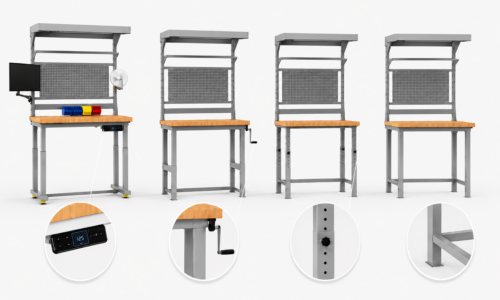
The challenge is that not all adjustment methods deliver the same level of functionality. While static, pin-adjustable, crank-adjustable, and electric height-adjustable workstations each have their place, the differences become increasingly important in fast-moving manufacturing environments.
Here’s a closer look at how they compare.
Static Workstations: Reliable, But Restrictive
Static workstations were built around consistency. One height. One setup. One intended workflow.
The problem is that manufacturing environments rarely operate that way anymore. What may work well for one employee or application can quickly become uncomfortable or inefficient for another.
When the workstation cannot adapt, the operator is forced to compensate instead. Over time, that often leads to unnecessary strain, fatigue, and reduced efficiency on the floor.
Pin-Adjustable Workstations: An Improvement with Limitations
Pin-adjustable systems were introduced to provide more flexibility than static benches while maintaining a relatively simple design. The challenge is usability.
Changing heights requires stopping work, manually repositioning components, and adjusting within fixed increments. While the workstation technically offers adjustability, the process itself can feel disruptive enough that operators avoid making changes consistently.
That becomes especially noticeable in fast-moving environments where efficiency matters and workflow interruptions add up quickly.
In theory, pin-adjustable systems improve ergonomics. In practice, ergonomic features only create value when operators actually use them.
Crank-Adjustable Workstations: Better Control, More Effort
Crank-adjustable workstations offer smoother movement and greater precision compared to pin-based systems. But despite those improvements, crank systems still rely entirely on manual effort.
Every adjustment takes time. Every height change interrupts workflow. In environments where operators are moving quickly between products, tasks, or shifts, even small inefficiencies can become larger operational frustrations over time.
Like pin-adjustable systems, crank solutions often fall into the category of “capable, but inconvenient.”
Electric Height Adjustment Removes the Barrier
Electric height-adjustable workstations change the conversation because they remove the effort from the adjustment process entirely.
Instead of interrupting workflow to manually reposition a workstation, operators can make immediate adjustments with the push of a button. That simplicity makes a significant difference in how the workstation is used throughout the day.
Operators can quickly adapt their workspace to fit the task, the product, or their preferred working position without slowing production down in the process.
Manufacturing Is No Longer Static
One of the biggest advantages of electric height-adjustable workstations is flexibility.
Modern manufacturing environments are constantly evolving: processes change, workflows shift, new products are introduced, teams move between stations. Facilities are expected to adapt quickly without sacrificing efficiency.
Static infrastructure creates limitations in environments that require adaptability.
Electric systems create the opposite. They allow workstations to evolve alongside the operation instead of forcing the operation to work around fixed equipment.
That flexibility becomes increasingly valuable over time, especially in facilities focused on lean manufacturing, continuous improvement, and workforce retention.
The Upfront Cost Conversation
Electric systems are often viewed through the lens of upfront price alone. But that comparison misses the bigger operational picture.
The real question is not:
“What costs less today?”
The better question is:
“What creates the most value over the next several years?”
When workstations contribute to:
- Improved efficiency
- Better ergonomics
- Increased adaptability
- Faster workflow adjustments
- Reduced operator strain
- Greater long-term flexibility
the investment conversation changes significantly.
Why BUILT Systems Focuses on Electric Height-Adjustable Solutions
At BUILT Systems, we believe industrial workstations should actively improve the way manufacturing environments operate.
Today’s manufacturers need more than durability alone. They need flexibility, adaptability, and ergonomic solutions that operators will actually use.
Electric height-adjustable workstations help deliver all three.