

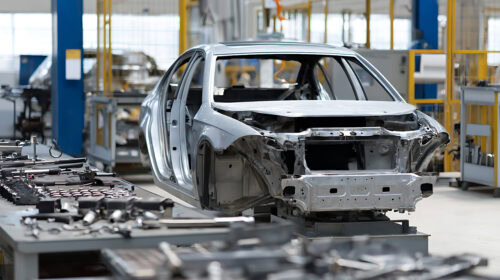
Automotive assembly environments demand speed, precision, and durability. From installing interior components to assembling complex mechanical systems, workers perform highly repetitive tasks that require consistency and accuracy.
The workstation supporting these tasks plays a critical role in overall production performance. A well-designed workstation does more than provide a surface — it supports operator ergonomics, improves workflow, and helps maintain consistent quality across the assembly line.
What Automotive Assembly Operations Look Like
Automotive manufacturing is typically divided into four primary stages:
- Stamping – forming metal components from sheet steel
- Body Shop – welding and assembling the vehicle structure
- Paint Shop – applying coatings and finishes
- Final Assembly – installing components and completing the vehicle
Workstations play the most critical role during final assembly, where operators install hundreds of individual components into each vehicle.
These environments are built around standardized cycle times, where each workstation completes a defined set of tasks before the vehicle moves to the next station. According to the International Labor Organization, this structured approach ensures consistent production flow and repeatable processes.
Because of this, workstation design directly impacts how efficiently each task can be completed.
When Automotive Assembly Uses Workstations vs. In-Vehicle Assembly
Not all automotive assembly happens directly inside the vehicle. While final installation occurs on the main assembly line, a significant portion of the work is completed at dedicated workstations before components ever reach the vehicle.
Understanding this distinction is key to understanding where workstations provide the most value.
In-Vehicle Assembly (On the Line)
As a vehicle moves down the final assembly line, operators install larger components directly into the vehicle body. This typically includes:
- seats installation
- dashboard placement
- doors being mounted to the body
- large mechanical components
These tasks happen at the vehicle, often supported by lift assists, positioning equipment, and overhead tools. In these cases, the “workstation” is less of a traditional bench and more of a line-side setup designed to support the operator as they work on the vehicle itself.
Workstation-Based Subassembly (Off the Line)
Before many components are installed into the vehicle, they are built and prepared at dedicated workstations. This is where workstations play a critical role.
Common examples include:
Door module assembly
Complete door systems—including wiring, electronics, speakers, and trim—are assembled at a workstation. The finished module is then transferred to the main line and installed as a single unit.
Seat assembly
Seats are fully or partially assembled at workstations before being brought to the vehicle. This allows operators to work more efficiently with better access to all sides of the product.
Dashboard assembly
Dashboards are often preassembled with wiring harnesses, controls, and displays at a workstation, then installed into the vehicle as a complete unit.
Wiring harness preparation
Harnesses are routed, clipped, and organized at workstations before installation, reducing complexity during final assembly.
Durable Construction for Demanding Automotive Environments
Automotive assembly places continuous stress on workstation structures. Equipment must support varying loads—from lightweight components to heavy subassemblies—while maintaining stability through constant use.
BUILT Systems’ industrial workstations are designed with cold-rolled steel and anti-vibration Mighty Mounts to provide the rigidity required for these environments. This is especially important when using torque tools or assembling precision components, where even slight movement can affect quality.
Durability ensures consistent assembly accuracy, reduced vibration during fastening, long-term reliability across multiple shifts, lower maintenance and downtime.
Workstation Tops: Built for the Application
In automotive assembly, the work surface itself is just as important as the structure underneath it. Workstation tops are selected based on the specific task, materials, and tools being used.
Rather than using a one-size-fits-all surface, manufacturers often choose from a range of specialized worksurface materials:
Steel tops
Used for heavy-duty applications and mechanical assembly. These provide maximum durability and impact resistance when working with metal components and tooling.
Laminate tops
Common in lighter assembly areas, such as interior components. These surfaces help protect parts from scratches or cosmetic damage during assembly.
ESD (Electrostatic Discharge) surfaces
Used when assembling electronic components to prevent static damage to sensitive parts.
Rubber or impact-resistant surfaces
Provide grip and help protect both the product and the workstation during repetitive assembly tasks.
Fixture-integrated tops
In many cases, the work surface includes built-in fixtures or mounting points that hold components in a consistent position, improving accuracy and repeatability.
Selecting the right worksurface helps ensure both product protection and long-term durability, while also supporting the specific needs of each assembly process.
Height Adjustability for Operator Ergonomics
Assembly tasks often require operators to work at varying heights. Fixed workstations can lead to poor posture, increasing fatigue and injury risk.
Height-adjustable workstations allow operators to position the work surface correctly for each task, improving comfort and reducing strain. This is especially valuable in multi-shift environments where different operators use the same station.
Ergonomic workstation design has a measurable impact on both safety and productivity.
Research from the National Institute for Occupational Safety and Health shows that improved ergonomics can reduce strain while improving task performance.
Manufacturers that invest in ergonomic workstations often see:
- reduced injury rates
- lower operator fatigue
- improved consistency
- increased productivity
BUILT System’s standard workstations feature electric height adjustment. They are designed to be able to move to an ergonomic height with the simple push of a button. In high-volume automotive production, these improvements scale quickly across the entire operation.
Supporting Efficiency on the Assembly Line
Automotive manufacturing relies on a combination of in-vehicle assembly and workstation-based subassembly. Together, these processes create an efficient and scalable production system.
Workstations play a critical role by preparing components before they reach the vehicle, allowing final assembly to move faster and more consistently.
From light-duty assembly applications supported by the BUILT ATE150 to heavier, more demanding processes requiring the strength of the BUILT’s heavy duty workbenches, selecting the right workstation ensures long-term performance and efficiency.
At BUILT Systems, industrial workstations are designed to meet the demands of modern automotive assembly — delivering the durability, flexibility, and performance required on today’s production floors.