


The packing industry is a critical part of manufacturing that focuses on preparing finished goods for storage, transport, and delivery. It sits at the intersection of production and distribution, acting as the final touchpoint before products leave the facility.
Within a manufacturing environment, packing includes activities like placing products into protective packaging, adding labels, sealing containers, weighing shipments, preparing cartons or pallets for carriers, and creating consistent customer experiences.
According to a Fortune Business Insights market report, the global packaging market (which includes both materials and the packing processes that handle them) was valued at USD 1,080.13 billion in 2024 and is projected to grow to USD 1,452.86 billion by 2032, with a compound annual growth rate (CAGR) of 3.93% during that period.
This growth reflects the rising global need for packed products in sectors like food and beverages, pharmaceuticals, cosmetics, and consumer goods — each of which depends on effective packing systems to protect products, communicate information, and get items to market quickly.
Why The Packing Industry Matters
A well-designed packing process reduces shipping errors, minimizes product damage, and improves order accuracy. In high-volume manufacturing environments, packing also affects labor costs and warehouse flow due to inefficient workstations creating bottlenecks and slowing down the entire operation.
When these workstations are designed well, packing becomes a highly repeatable, predictable process that supports faster shipping times and fewer handling errors.
As manufacturing continues to move faster and more data-driven, packing stations are expected to support real-time tracking, automated labeling, and integration with warehouse management and inventory systems. This has made the design of packing workstations a critical part of modern manufacturing infrastructure.
Requirements for a Packing Workstation
A packing workstation has very specific demands compared to general assembly or fabrication tables. The work surface must be strong and durable, able to handle repeated impact from cartons, tools, tape guns, and products. Equally important is ergonomic design, which directly affects operator comfort, productivity, and safety.
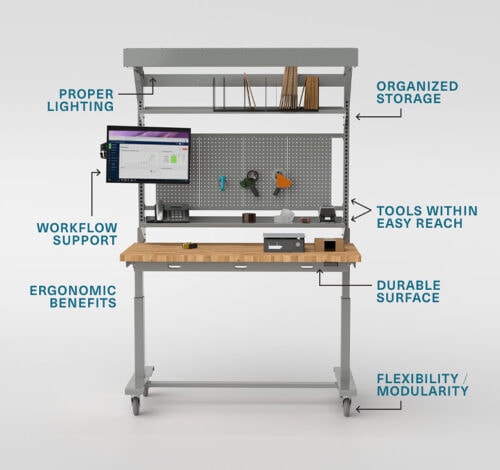
The height of the surface should allow workers to maintain a natural posture, with elbows bent roughly at a 90-degree angle, minimizing strain on the shoulders, back, and wrists. For operators who stand for long shifts or handle products of varying sizes, adjustable-height tables are ideal, as they allow the workstation to be tailored to the individual’s body and task requirements.
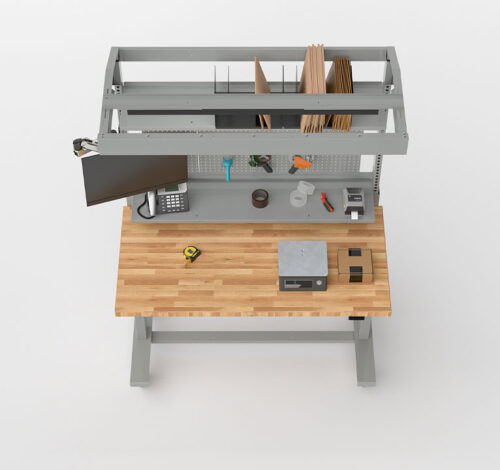
Ergonomics also extends to the layout of tools and supplies and a well-designed packing station needs to support the flow of work. Scales, printers, scanners, and sealing tools should be placed where they are easy to reach without twisting or bending. Storage for boxes, tape, filler, and labels should be organized so that frequently used materials stay close to the operator while less-used supplies are kept out of the way. Proper lighting is also critical, as packing often involves reading small labels and visually inspecting products before sealing.
At the same time, flexibility is essential. Modern manufacturing environments must adapt to seasonal spikes, expanding product lines, and changing packaging formats. Workstations that can be adjusted or reconfigured allow operations teams to adapt without replacing entire systems.
Workflows and KPIs
In most manufacturing and fulfillment operations, packing follows a standard workflow that ensures products are accurately and efficiently prepared for shipment. This process usually begins with picking the items for an order, followed by verification and inspection to confirm that the correct products are being packed and that they meet quality standards. Next comes the packing stage, where items are placed into boxes, void-fill or cushioning is added, and packages are sealed. After packing, each shipment is weighed and labeled for tracking and shipping compliance, and finally, the packages are staged for the carrier to move them into the distribution system.
To measure the effectiveness of packing operations, manufacturers track several key performance indicators (KPIs). These include throughput (orders/hour or parcels/hour); pick and pack accuracy (which reflects the error rate in fulfilling orders), damage rate, labor cost per order, average pack time, and packaging waste (measured either by weight or cost).
Continuous improvement initiatives in the packing industry often focus on reducing unnecessary motion, standardizing carton sizes, and automating repetitive tasks. By analyzing workflows and KPIs, manufacturers can identify bottlenecks, improve efficiency, and create safer, more ergonomic packing stations that support both operators and operational goals.
Types of Packing Workstations
Packing workstations vary by throughput and product, but common station types include:
- Manual packing bench (single-operator): a sturdy table with an ergonomic work surface used for small batch packing, kitting, or fragile items.
- E-commerce packing station: optimized for speed – integrated scales, label printer, scanner, tape/heat sealer, easily-reachable supplies, and overhead shelving for quick access to materials.
- Conveyor-fed packing station: sits on a conveyor line – operators perform final pack/seal steps as items move past.
- Automated packaging island: uses measuring, robotic bagging or box-erecting, automated void-fill and print-and-apply labeling for high-volume single-SKU or dynamic-size packing.
- Kitting and inspection benches: combine packing with quality checks and documentation (often used in regulated industries).
Design guidance and common needs for these stations emphasize adjustable, durable work surfaces, integrated scales and printers, proper lighting, storage for boxes and consumables, and accessories like tape guns, cutters and ergonomically placed scanners.
How BUILT Systems Fits into the Packing Category
BULT Systems designs and supplies industrial workstations and production tables that map directly to the needs of packing and shipping operations. Here’s how our products (and standard configurations) support packing workflows:
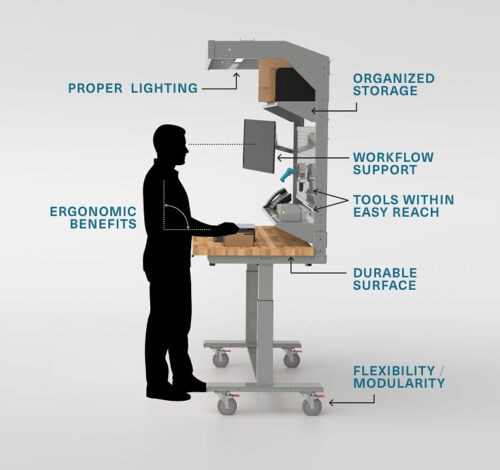 Ergonomic-first design: BUILT Systems’ workbenches emphasize ergonomics with our electric height adjustable bases and configurability, which reduces operator strain and improves pack speed and accuracy. This aligns with best practices that show ergonomic stations reduce cycle times and injuries.
- Modularity & accessories-ready: our standard stations are built to accept common accessories: monitor arms, shelves, tool bins, etc. That means a packing line can start simple and scale up with automation without replacing core benches.
- Durable all-steel fabrication: BUILT Systems’ metal legs and frames are made for industrial use (steel construction, powder coat options). That durability is important in packing zones that see constant impact from boxes, tape and handling tools.
- Standard solutions for faster deployment: BUILT Systems focuses on standard, repeatable offerings that make it easy for dealers and distribution partners to specify and deploy packing stations quickly.
- Customization where needed: while our core approach emphasizes standard products, we can accommodate custom workstations for packing needs on a case-by-case basis.
Packing Workstations as a Competitive Advantage
 In modern manufacturing, the packing industry is no longer just a support function. It is a strategic part of operations that impacts brand reputation, shipping costs, and customer satisfaction. Efficient, ergonomic packing workstations help manufacturers scale faster, reduce errors, and protect both workers and products.
By using industrial packing workstations from BUILT Systems, manufacturers can create safer, more efficient packing environments that support long-term operational growth. Learn more about our standard workstations by visiting https://www.builtsystems.net/our-products/.